Sunday, May 30, 2010

What's The problem with "going viral"

In an era of downward cost pressures, advertisers are looking for the biggest bang for the littlest buck. Typically, that means going "viral." And typically that means an advertiser asks its agency to make their advertising something that will "go viral."

The problem with this, of course, is implied by the very word "viral."
The key to virality is in the word "viral." Think H1N1 -- we do not mean to give it; we do not mean to get it. If we get it, we spread it. If we don't, we may be none the wiser. Or, perhaps, we hear about others we know -- friends, co-workers, loved ones -- getting it. But ultimately, the intentionality of "viral" is not what makes something viral. There is a je ne sais quoi about the little piece of content -- that marketing artifact of culture -- that makes you want to share it with others. Though, when you think about it, then it isn't really viral at all; but let's not quibble right now with a precise definition of the word.

What makes something viral is in no small part its authenticity. The intentional structure of marketing is in direct violation of this authenticity. (This is also what plagues the use of social networking platforms for the purposes of marketing, but that's another subject for another column.) Part of the faux authenticity that marketers seek in a quest for viral, and what lies at the heart of marketers' belief that something can be made viral, is really just head-faking an intended audience -- trying to make that audience believe that what's being done isn't marketing.

This means that an advertiser is found asking its agency to make advertising that won't be perceived as advertising. The protagonist of the value proposition narrative is neutered in the hopes of not seeming obvious that what marketing is trying to do is -- marketing.

What hurts so much is not that marketing tries to sell the hero of its narrative. The problem with marketing is that it tries to pretend that it is not trying to sell the hero of its narrative. Direct response works because it makes no pretense about its intention. When you see an ad for the ShamWow or OxiClean, it's no secret what the objective is. But when a brand like Miracle Whip tries to get friends on Facebook? The brand becomes a poseur (though it does have just fewer than 20,000 fans).

Viral marketing isn't a strategy. It's not even a tactic. Viral is a possible outcome that brings an unplanned life to a piece of advertising.

Yes, video of Saddam Hussein's execution or video of frat boys setting their farts on fire or cats playing the piano might attract a great deal of attention and gain exposure through word of mouth, but these things are not marketing, nor do they, as content, possess qualities that can or should be associated with marketing in order to somehow render that marketing "viral."

The fact that things like the above attract a large audience has a lot more to do with human prurient interest, our media-trained thirst for sensational spectacle, or our need for a shameful giggle. The same can be said of a lot of visual stimuli online -- hence the popularity of fat ladies falling off of trampolines or combustible effluvium. But these things are not viral. They are "popular," with their popularity having little or no relation to their quality as content. And they're certainly not great for marketing (unless you are selling trampolines or Zippos).
Among the qualities your marketing should have if it is going to have a chance of going viral are:
  • Entertainment -- the unit has entertainment value.
  • Utility -- the unit offers something the reader can use.
  • Palpable reward -- the unit offers instant gratification.
  • Uniqueness -- the unit is like nothing the reader has ever seen.
But when you get right down to it, this really should be part of any piece of creative product being proffered in the 21st century.

The truth is that the best one can hope for is, to paraphrase Peter Shankman, CEO of The Geek Factory and PR/marketing warlord, to make your marketing great. If you've done that, the rest will take care of itself, and viral will simply be one of the many symptoms

Friday, May 28, 2010

Successful Tips to Grow Your Business

Facebook..they have to accept us to be a fan.  And then how do you market to them IF that happens.

Local TV/Cable seems to be losing viewers to their online storage of old episodes or like HULU.com….No local ads there to buy…….
Newspaper…..Rapidly losing readership and the young don’t even bother at all.
Radio…..As a Ford store…I know how many people are tuning into Satellite Radio and extending their subscription.

Yes, third party advertise on Cars.com…autotrader..etc   (yet I am using MY financed inventory to build their brick and mortar site and they keep raising their prices and offering “CONQUEST sponsorships so dealers can eat each other on their web site”…..Not interested in helping play that game long term.

So, as a middle age woman trying to figure out Social Media and spending money on the Internet…confuses me..
Not sure how to control dollars on Google…where to go to determine the legal laws,  etc.  I definitely, see more and more people shopping and making inquiries on our web-based marketing and scheduling online for their service appointments.

Where do you think a local car dealer should be addressing their social –web base marketing efforts.  How to reach those young professionals that don’t use local media?

Thursday, May 27, 2010

Facebook "Jumped The Shark"

Before we go any further I have to disclose that not only am I on Facebook...but I AM ON FACEBOOK 24 hours a day, or at least it seems.  Out of all the social networks I love the fact that everyone I know is on there.  I have all my friends, (and some people who are sort of friends, and some I just used to go to high school with and I haven't seen in 25 years), all in one place and I like seeing what they are up to and being able to communicate with them.  I am organizing a school reunion off Facebook.  I get it, I like it, I think it works.  The last sentence though might be the first sign of Facebook's demise.    

Remember when MySpace was cool, and everyone you knew was on MySpace?  Then suddenly people started trying to friend you that you didn't know are really didn't want to know.  It became the preying ground for hookers and strippers trying to get "dates".  I used to have at least 5 "friend" request on MySpace from people looking like Barbi and called "Trixie" who were going to be in my area for the night and, "wouldn't it be fun to get together"?  This ruined the experience and I stopped going and eventually changed over to Facebook.

The interesting thing though was, so did everyone else. It seemed that it was within a couple of months, no one used MySpace and everyone jumped to Facebook.  In the past couple of weeks Facebook has made some huge mistakes which has taken the shine off it's moniker.  Is everyone going to jump?    

What I want from my social network is to connect with my friends. I don't mind you selling advertising, or if I opt into a sales promotion using my data from that promotion to sell targeted advertising...what I do hold closely though is my privacy, and so do a lot of people.  On sunday Mark Zuckerberg, Facebook's clever young CEO, announced that they would be changing their privacy settings to make it easier for people to understand.  The problem is, trust is a fickle thing, a little bit like "Trixie" on MySpace, once you lose trust it's hard to gain back, (not sure what happens when you lose "Trixie", I suppose she friends another 1,000 people), my point being, just as "Trixie" pissed me off and made me switch from MySpace to Facebook, Facebook's seemingly total openness to offering up our likes, dislikes, friends, shopping habits, inside leg measurements to any group or advertiser could be their "Trixie"! In his announcement Zuckerberg didn't apologize nor did he say he would ask permission to use our information, only that they would change the privacy settings.

This is a dangerous move.  Make it clear, and be humble to the people who are your customers...apologize, make it clear that without opting into anything non of your information is going to be shared, why he didn't do this is beyond me.  Five of my friends have discussed jumping ship on Facebook.  The movement might have started...    


Unlike some people blogging on Facebook I don't see Zuckerberg as an evil tyrant willing to sell any of his members down the river, I think they're hit the wall.  Facebook is closing in on half a billion people... let's just think on that, more people than the population of America!  An average TV network will have a reach of around 60 million households.  With an average of three people in a household that's only 180 million, and there's no guarantee that just because your TV channel comes into their living room, that they will watch. Facebook has over 400 million active users! Let's play naive and do some quick math.  The average cable channel, with minimum targeting gets a $20 CPM.  On a one impression basis Facebook is worth $8 million a month, but we all know that a visit to Facebook will probably garner an average of about 10 impressions, so let's bump that to $80 million a month.  But the $20 CPM blended on Facebook is probably $15, so that puts us at $60,000,000 or $720,000,000 a year, not far off what they're actually making. Facebook has hit it's first wall.  The only way to build you business is:  

1: Attract more people, (well they might be hitting a wall there).
2: Charge a higher premium price for your inventory, (hitting the wall here on standard no targeted information).
3: Create new inventory options previously not available.
4: Have "Trixie" offer a free lap dance to every person breaking 1,000 impressions a month!   


What Facebook is left with is option three, (although I hear option four was a close second).  They have to offer advertisers something they hadn't been offered before.  I don't see video pre-roll insertion yet, not seeing much in the way of standard banner, not seeing "buy outs" for movies, screenings, but I am seeing Facebook giving away my personal information.  It's the wrong way to go in this business. In my opinion it's the easiest way to loose your customers. Is Facebook jumping the shark...we'll see!

Wednesday, May 26, 2010

The brands that "get" digital: Appealing creative showcase

Digital marketing isn't about finding the biggest possible bullhorn through which to shout your message. It's about forging meaningful, durable connections with the audiences that really matter to your business. And let's face it -- your audience isn't all 6.8 billion people on this planet. It's a sub-sub-sub-sub-sub-set of that. (And for some of you niche brands out there, throw on a few more subs as needed.)

The challenge, then, is not developing killer digital creative. It's developing creative that your audience thinks is killer. So how can you get inside the heads of consumers with whom you might have very little in common demographically? It never hurts to ask the experts.

At this year's ad:tech San Francisco, five digital marketing specialists showcased stellar digital creative executions across five key demographics categories:
  • Moms
  • Men aged 18-34
  • Teens and millennials
  • Multicultural audiences
  • Boomers and beyond
Take a look at these evocative, engaging case studies and learn how you can deliver uniquely relevant messages that drive targeted audiences to respond and act.

Tuesday, May 25, 2010

All about Performance marketing: Avoid the newbie mistakes

Simply defined, performance marketing is the practice of advertisers and media vendors sharing the marketing risk in various degrees -- from cost-per-click arrangements to revenue sharing, and all points in between.

Sadly, major online media vendors continue try to dodge an inevitable onslaught of dynamic CPMs driven by demand-side platforms (DSPs) and make excuses for why they don't accept CPC deals. However, as advertisers continue their inevitable march to eliminate marketing waste, resistance to lower-risk performance marketing arrangements will ultimately be futile. And the reason for this progression is tracked digital media.

Because more companies will need to consider performance marketing in 2010, this guide to avoiding newbie mistakes should help you navigate the setup and manage performance marketing arrangements more effectively.

Is my company or my client right for performance?
I won't be cavalier and suggest that every company should convert their CPM media buys to performance media. But here are some situations where performance strategies thrive:
  • For the action-oriented. Consider performance media if your brand or offer requires some form of user action to realize the value.
  • For unique clients with minimal channel conflicts. Focus on clients and their product offers that don't have many alternative sales channels to circumvent.
  • Where a phased start is a viable option. For a shift to lightweight performance marketing, consider shifting CPM buys to CPC buys, which shifts the media risk partially to vendors.
  • When simple actions are ideal. If you're looking to achieve simple objectives, such as email sign-ups, contest entries, or friending activities in social media, definitely consider performance media.
  • When free trials or low-cost deals can help you win big. If you offer software on a free trial basis or market a low-cost (under $100) product and are willing to make an unconditional satisfaction guarantee, don't wait another day -- get started.
Let me add one caveat to the above: Lead generation is for experts only. Be careful with cost-per-lead (CPL) arrangements using performance media. In fact, avoid any affiliate marketing arrangements where you don't have a direct connection with the actual media vendor -- there is too much incentive here for scammer affiliates to enter fake data. (Instead, approach media vendors directly.)

Who are the performance media vendors?
As performance media continues to emerge in mainstream channels, I want to introduce a term -- "tradigital" -- to represent traditional digital media vendors (think CPM buys), so we can separate them from "traditional" performance media vendors.

Surprisingly, few digital marketers know the categories of performance media vendors, let alone the names of those vendors. Here are the principal players:
  • Search engines. These are primary purveyors of CPC media opportunities with the added benefit that visitors have been searching for your products/services.
  • Websites. Since websites tend not to sell out their inventory and ad network backfill is often too cheap, website/portal owners are increasingly open to performance arrangements from attractive brands.
  • "Tradigital" ad networks. Ad networks have access to so much cheap premium media that the smarter ones welcome the opportunity to test a performance arrangement. Smart media buyers will begin to shift a portion of the CPM media to CPM/CPA hybrids, which tends to result in a discount to the effective CPM.
  • Affiliate networks. Although best for CPA offers for online purchases, affiliate networks like LinkShare and Commission Junction work well for brands that are comfortable with basic performance media buys and are ready to move to the next level. Oddly enough, affiliate marketing tends to be the first channel companies leverage. For a number of reasons, it often makes sense to wait until other performance media arrangements are in place before approaching affiliate networks.
  • Emailers. A little secret in performance marketing is that more than 50 percent of total performance transaction volume is driven by email list owners who have developed loyal audiences that respond to offers sent to their lists. Because the cost to generate revenue through email deliveries is almost nil, the area attracts both winners and some real shady characters. So it's important to check references of customers of emailer partners. Professional performance media agencies generally know the winners from the losers.

Monday, May 24, 2010

Social Marketing for freshers

Marketing managers should know by now that the success of their social media program largely depends on the thoughtful alignment of message and medium. Of course, it's not quite as simple as setting up a Hootsuite dashboard and cruising on conversational auto-pilot. More and more, marketing departments are bringing full-time social media or community managers on board to take the helm as conversation-starters, problem-solvers, and customer supporters, all while navigating the choppy waters of building brand equity across the social web.

But the market is currently saturated with so-called social media experts, so how do you find the right fit for your brand?

5 straightforward tips....
Here are five straightforward tips for refining the pool of hopeful applicants:

1. Immediately discard all resumes for any "gurus," "evangelists," and especially "ninjas"

An April post on the LinkedIn blog highlighted the recent surge of the term "ninja" among the site's millions of registered users (it seems that the term "guru" has been on the down slope since 2008), with a particular concentration among social media-oriented profiles.

Of course there are people who do have certifiable expertise in the constantly evolving world of social media. But it's more likely that they're out there demonstrating, not advertising their savvy. Qualified candidates are participating on an authentic level rather than racking up thousands of followers; they're creating content rather than cranking out "me-too" posts; and if they do have any ninja moves, it's probably from dodging any references to being a "guru."

A good piece of advice is to "fish where the fish are," meaning within your own network. Look around. Might you already have some lively and articulate contributors in your organization who have social media participation baked into their daily lives? Similarly, you might consider exploring your own (or related) social networks for individuals who are already prolific and vocal brand enthusiasts whose perspective is trusted and respected.

2. Follow the path of their digital footprint
Is your candidate's digital footprint a well-worn path, or is it a tentative toe in the water? While most organizations would benefit from the infusion of youthful energy that a plugged-in member of Generation Y could bring to the table, it's important to assess whether or not your prospective social media manager has real influence and reach in his or her networks.

Has the candidate been blogging on some topic of interest for a steady period of time? Is it apparent that the candidate has actively contributed or participated in meaningful conversations in social forums? Have they presented a consistent (and transparent) persona across all of their social networks? 

Helping to build your brand's social currency is not necessarily a numbers game, as recent research (PDF) has begun to reveal. To find the right person, "connectedness" is key, but quality of their content, networks, and interactions speaks more loudly than quantity, and influential networks aren't built overnight.

Sunday, May 23, 2010

Tips to hire right social media manager

Marketing managers should know by now that the success of their social media program largely depends on the thoughtful alignment of message and medium. Of course, it's not quite as simple as setting up a Hootsuite dashboard and cruising on conversational auto-pilot. More and more, marketing departments are bringing full-time social media or community managers on board to take the helm as conversation-starters, problem-solvers, and customer supporters, all while navigating the choppy waters of building brand equity across the social web.

But the market is currently saturated with so-called social media experts, so how do you find the right fit for your brand?

Looking for killer talent? For more help finding a job or placing a job listing, check out iMedia's Job Connection.
Here are five straightforward tips for refining the pool of hopeful applicants:

1. Immediately discard all resumes for any "gurus," "evangelists," and especially "ninjas"

An April post on the LinkedIn blog highlighted the recent surge of the term "ninja" among the site's millions of registered users (it seems that the term "guru" has been on the down slope since 2008), with a particular concentration among social media-oriented profiles.

Of course there are people who do have certifiable expertise in the constantly evolving world of social media. But it's more likely that they're out there demonstrating, not advertising their savvy. Qualified candidates are participating on an authentic level rather than racking up thousands of followers; they're creating content rather than cranking out "me-too" posts; and if they do have any ninja moves, it's probably from dodging any references to being a "guru."
A good piece of advice is to "fish where the fish are," meaning within your own network. Look around. Might you already have some lively and articulate contributors in your organization who have social media participation baked into their daily lives? Similarly, you might consider exploring your own (or related) social networks for individuals who are already prolific and vocal brand enthusiasts whose perspective is trusted and respected.

2. Follow the path of their digital footprint
Is your candidate's digital footprint a well-worn path, or is it a tentative toe in the water? While most organizations would benefit from the infusion of youthful energy that a plugged-in member of Generation Y could bring to the table, it's important to assess whether or not your prospective social media manager has real influence and reach in his or her networks.

Has the candidate been blogging on some topic of interest for a steady period of time? Is it apparent that the candidate has actively contributed or participated in meaningful conversations in social forums? Have they presented a consistent (and transparent) persona across all of their social networks? 

Helping to build your brand's social currency is not necessarily a numbers game, as recent research (PDF) has begun to reveal. To find the right person, "connectedness" is key, but quality of their content, networks, and interactions speaks more loudly than quantity, and influential networks aren't built overnight.

Friday, May 21, 2010

Ten signs for a social media makeover

Common misconceptions and pitfalls
In the year of the social media revolution, we've seen many brands, organizations, and individuals jump in and make a concerted effort to expand their presences online and establish their social media footprints. Some of these brands have done a great job and really understand the importance of social media in getting people aware and engaged -- while others are latching on to the newest trend and, perhaps, going through the motions to keep up with the Joneses.

Among the more than 3 million businesses creating Facebook pages and groups -- not to mention millions of special-interest and community-driven blogs, up to 70 percent of which blog about brands -- many have failed to connect the dots in terms of how to use these platforms effectively. Many brands fail to leverage social spaces to drive awareness and engagement among their customers and fans. They simply aren't having conversations about their brands in the places their audiences share most.

Stay informed. For more tips on enhancing your brand's social marketing initiatives, attend the iMedia Brand Summit, June 12-16. Learn more.
To provide a little background on me: I run a social media marketing agency (KARMA Media Labs) that helps organizations and individuals connect with target audiences and build word of mouth in the communities where they live. In my time working with partners to outline social media strategies, I've seen many assumptions and preconceived notions about social media -- what it is, how to use it correctly, and how it fits into a brand's overall marketing and media strategy.

So how do you know your brand needs an extreme social media makeover? Here are some top signs, misconceptions, and pitfalls I've encountered when diagnosing a social media emergency.

Thursday, May 20, 2010

30-minute-a-day link building plan

Link building requires an enormous investment of time and resources. Like any major investment, however, you can break the "payments" down into smaller, more manageable increments. Here's how to build links for your website in just 30 minutes a day (for the rest of your life).

Start your day each day with the following assignments, and work concertedly for a full 30 minutes. You will be amazed at what you can accomplish.

Day 1: Linkable asset identificationWhat about your website or organization is "linkable?" Use your first day's 30 minutes to brainstorm a list, in a spreadsheet, of every tangible and intangible aspect of your organization and website that could make others interested in linking. Some common linkable assets include webinars, job listing pages, PDFs, blogs, forums, subject matter experts, deals, news, a community participant, contests, podcasts, and free tools.

Deliverable: Open your spread sheet and make a column for the asset, and then another column for the corresponding URL from your website, if applicable.

Day 2: Link opportunity prospecting
On your second day, begin prospecting for link opportunities. Because you only have 30 minutes, it's best to only focus on a single linkable asset. So pick one from your spreadsheet and then open up a new tab and name this new tab after the asset you're focusing on. Next, select a single keyword that best describes your market. For example, if your site is a golf equipment retailer, select golf. If you're a CRM consulting firm, go with CRM. Work this keyword through the following link building query generators:
Deliverable: When you find a link prospect in the SERPs, copy and paste it into your new sheet. Be sure to record the queries that find you the most prospects in the top 10. Those will be worth coming back to later.

Day 3: Link prospect qualification
Open your sheet back up and take a look at the URLs you recorded yesterday. Are the pages on credible websites that seem like solid contributors to your industry with real relevance to your company? If not, cut them out. If they do, then look for contact information. If you're done before 30 minutes are up, go back and do a bit more prospecting. It's typical during the qualification stage to gain new insights and ideas for queries.

Deliverable: A shortened, qualified list of link prospects along with contact information.

Day 4: Outreach and acquisition
Depending on your prospects, acquisition can be as simple as submitting PDFs to a directory or sending a quick email to tips@industrynewssite.com. Spend a few minutes working on your outreach email, and keep it humble, formal, and to the point. Then start on your list.

Deliverable: Make a note in your spreadsheet after you've contacted each person on your list.

Day 5: Regroup, respond, repeat
Day five is for responding to any emails and requests you got from your outreach. Once you're caught up with your correspondence, you need to pick your next step: Either look for more opportunities for this particular asset, or move on to another on your list.

Deliverable: Make notes of all the responses you receive and add any links acquired to a new list. Be sure to track these links in analytics to see how much traffic they send, and whether or not there are any conversions. Finally, know which asset you're starting on at the beginning of next week.

The most important step is the first one: deciding to act. As in many things in marketing and life, you learn as you go. Though 30 minutes a day isn't much time, it's certainly enough to take some basic steps towards link building and will help you judge where exactly you should spend more time and resources in the future.

Wednesday, May 19, 2010

Facebook's new functions

With its recent F8 announcements, Facebook has again one-upped the world as we thought we knew it. Brand marketers need to start looking at Facebook as a much deeper and broader solution than one that purely amasses a fan base. As Facebook rolls out new functionality, brands have the opportunity to act immediately in a variety of ways. In addition, it's important for brand managers to re-imagine their brands by leveraging social enhancements


Brands need to be able to take immediate advantage of features such as the "like" functionality, but they also need to be visionary in how they can build their brands for the future and become truly social. While I encourage brands to take part in these new advancements, we also need to make sure that we keep an eye on the Facebook future and build with this future in mind.

So, in the quest to make your brand truly social, uproot your assets and think of new ways to infuse them through Facebook integration and by adding key social layers to the brand experience. Look toward the future and start evaluating the role that Facebook can play at retail, on the ground, and across every channel your brand touches. Not all opportunities will be a fit, but one thing is for sure: If you only look at Facebook as a place to have a fan page, you are missing the greater offering and will likely be sitting on the sidelines when the future arrives.

Let's take a look at some of Facebook's new and evolving functionalities, as well as what they mean for your marketing efforts.

Way to climb the agency ladder

I have to tell you up front that I've never followed the traditional track of working my way up through the agency world. I came upon the industry, didn't like what I saw, and started doing things my way from the beginning. 

I haven't put in the 100 hour weeks on Madison Avenue or slaved away under the dictatorship of an angry creative director. I have launched two digital agencies, worked with a variety of great clients, and now find myself at Campfire where I am a creative director and partner and work on some of the most innovative and strategic campaigns out there. But I do know is that there are basic principles that apply to any career advancement and certainly apply in the agency world.

Monday, May 17, 2010

What a Mess?

I am not a neat freak by any means.  As a matter of fact, I think you might call me a bit of a slob.  While I don’t leave food laying around I am not one to put things up after I am done using them.  I tend to leave clothes where I take them off and when I know I have company coming over I scramble to clean up a little.

After work today I was invited over to a friend’s place to watch a couple of movies, have a few beers and just generally hang out.  The first thing out of his wife’s mouth when I walked into their home was “Don’t mind the mess.”  As I looked around I noticed that the place was spotless.  Everything seemed to have its place, the floor was clean, no Coke cans or beer bottles laying around — it smelled nice and everything.  I asked her “what mess?” She giggled and me and my friend visited.

It got me thinking about other times when I visited a friend with a clean home.  Each time it seems they said at the beginning of the visit “Don’t mind the mess” or something similar.  It’s almost as if that phrase has become a general greeting for anyone entering your home, even if the place is perfectly clean and tidy.  Maybe people say it in case they missed something in a back room that you might come across by chance; I don’t know.

It just strikes me as a bit unnecessary to apologize for something that doesn’t exist.  Perhaps people subconsciously want the hard work they put into keeping the place clean noticed and do so by bringing attention to a mess that does not exist.  Whatever the reason, I was wondering how many of you neat freaks out there do this when you have visitors.  

Do you immediately apologize for having a messy home when it is perfectly acceptable?  Do you even realize that your home is clean? I’ve been in homes that were absolutely filthy and not one word of apologies came from those people.  It’s only when I go to someone’s home that keeps it clean enough to be featured in a home owner’s magazine.

Saturday, May 15, 2010

Six ways to simplify social media updates

For many marketers, the explosive growth of social networking isn't raising questions about whether to engage audiences on these platforms but, rather, how to manage multiple network accounts in an effort to reach a larger, more-targeted audience while generating sustainable results.
But when it comes to reaching out to more users on social networks, organisations are stuck.

Advertisers and marketers realize they must be involved in social marketing, but they are becoming disillusioned with results from super social networks like Facebook and MySpace, which leads to tabling these customer-facing initiatives. To get unstuck, marketers need to plan how they will expand content distribution to relevant audiences across multiple networks to initiate new dialogs. 

One of the major barriers marketers face when attempting to communicate on social networks is streamlining the content distribution process for posting on numerous profiles. It's challenging to increase engagement opportunities and manage customer-facing dialogs across multiple platforms with limited budgets, smaller staffs, and no tools to automate the process.
 
This management challenge creates an engagement gap in two ways. Marketers are not only missing out on a dialogue with thousands of users who are already fans of their product or service, but are also missing valuable opportunities to reach out to new audiences on lesser-known online communities, simply because they don't have the time or tools to connect with more people.
Marketers can avoid the engagement gap and expand their outreach and dialoging efforts by creating a hybrid content distribution process that leverages technology tools, therefore giving organizations more time to engage relevant and targeted individuals in dialogs. I call this approach social application marketing.

Social application marketing (SAM) is about using tools to create multiple layers of distribution that can be grouped by process. That way, you spend less time talking to a machine and more time engaging with your desired audiences. There are a number of process steps.

1. Set up two email accounts. You'll need Gmail and Yahoo Mail email accounts to activate and manage your profile and tools. I recommend setting up folders for each tool or application you create in order to quickly locate credential documents, as well as sort notification messages you may want to archive from each social network or tool site. Using a web-based email service also keeps your corporate email account clutter free from Twitter and Facebook account notification emails.

2. Claim your identity. Think of securing a username on a social network as owning a domain name for your company. In fact, screen name claiming needs to be integrated into your domain name buying process. You need to protect your online identity so that others don't try to hijack your brand, product, or service name. To streamline the process, don't check individual sites to see whether or not the name or names you need are still available, but instead look at 104 different sites at one time using UserName Check. The service doesn't include every tool or network you may be considering, but it will save you a lot of time in the selection of your organization's ID. If you're planning on really locking down your identity, you'll need to secure your i-names which are digital identifiers for individuals and organizations that begin with "=" for people and "@" for an organization. I like 1id.com, an accredited i-broker.

3. Register your identity and store your account information in an excel spreadsheet. When you're registering 75 or more profiles and over 4,000 screen names, you will need to archive the username and password information for each account. When you archive account credentials, be sure to include links to login pages along with the username, password, and name of the service or site. You will also need a column in your spreadsheet for application keys you'll need to remember for activating distribution tools (I'll get to that in just a moment). One additional tip when it comes to registering screen names:  Don't use the same password for every account. Minimize unauthorized access to your organization's accounts by using multiple passwords. That way, no single password grants an unwanted user universal access to all your accounts.

4. Populate your profile. Here comes the content (translation: here comes trouble). The best advice is to plan ahead. If you need legal reviews, disclaimers, insurance modifications (strange, I know, but trust me; this happened to a client), a corporate blogging policy, or even an online community guideline document, get them in place early so you can quickly plug in content from a Word document or spreadsheet. Content fundamentals you'll need to have at the ready to decorate your profile include: An avatar or image, an "about" statement, links to sites, historic info (jobs, titles, timeline for the launch of a product), and links to third-party content you want to plug in.

5. Dashboard the process of updating your social network profiles. Browser plugins are nice if you're just going to use one or two bookmarking tools, but if your organization is managing 15 to 25 profiles, you need to automate the publishing process across your accounts so you can spend more time talking to customers. This where many advertisers get stuck. They either don't have a publishing strategy or they are overwhelmed with how to quickly recognize a follower. I use two tools to automate publishing and simple "reply to" messaging: Ping.fm and TweetDeck. These tools turn your content into software. Use them to leverage the power of a distributor to reach more audiences.

6. Monitor and measure outcomes. There are a number of excellent free tools to help you monitor what people are saying, like Search.twitter.com and free Google alerts. In addition, streamline your feed data so that you don't get overwhelmed. I like FeedMyInbox.com because it is a simple feed management tool that is so easy to use. And don't forget to monitor message board feeds. Boardreader.com is still the best when it comes to monitoring these.
For brands interested in -- or even intimidated by -- social marketing campaigns, I hope this social application marketing framework will help you integrate and execute customer-facing engagement strategies into your organization's marketing and media plans.

Thursday, May 13, 2010

Multilingual PPC Campaigns Are the Order of the Day

In the world of PPC, making sure the campaign implemented is effective at all times is something that must be done thoroughly. There is no use spending thousands of your money only to get several clicks because the PPC campaign used is not effective. If you want to get the best results, the first thing you should do is understand your viewers and target markets.

Keep in mind that the Internet is available globally. If you are offering products and services available to global customers, you should also consider multilingual PPC campaigns. It is extremely necessary because English-based PPC campaigns may not work as good with foreign sites, disabling you from reaching potential customers from non-English-speaking parts of the world.

Plus, in the world of marketing the concept of demographic marketing is considered to be one of the most influential weapons to be used. By having multilingual PPC campaigns, your potential customers reading the ads will quickly feel connected to your business as well as products and services you are offering, increasing the chances of having the advertisement clicked substantially.

If you thing managing a multilingual campaign yourself is simply out of hand, you can also hire experts and freelancers to help you. Make sure the person you are hiring is speaking the language as their native tongue to make it easier to formulate effective ads in different languages. That is why professional PPC service providers always have ad writers with different cultural backgrounds to make sure the campaigns they are formulating remain effective.

Wednesday, May 12, 2010

Maximise Your Quality Score and Pay Less for PPC

Pay per Click or PPC advertising is easy and difficult to manage at the same time. Setting up a PPC advertising campaign is as easy as it can get, but refining the campaign to make sure you get the best results can be a bit tricky to do. There are, however, several keys you can use if you want to make sure the quality score of your PPC campaign constantly improves; that is exactly what we are going to discuss in this article.

The first key to improving the quality score of your PPC advertising campaign is review. Bear in mind that improved PPC campaign quality score means generally cheaper costs, which will make the overall campaign even more beneficial for you. Simply go through the click-through logs and various reports to see different angels of the campaign.

Next, you need to adapt the campaign to suit the latest situation. The market is changing all the time, and continually refining your PPC advertising campaign can seriously make the overall campaign that much more effective. With the right approach, you can actually make your PPC advertising campaign a lot more beneficial with refined keywords and ads.

Last but not least, modify the campaign when you have to. A lot of internet marketers make the mistake of not wanting to modify the grand PPC advertising campaign they have formulated just because they don’t want to go through all the trouble of modifying aspects of the campaign. Although adaptation can keep your campaign in line with the market, modification can actually make your campaign – and of course the product being advertised – stands out and get the right recognition.

Tuesday, May 11, 2010

Adwords Max Budget a nightmare

As you may have heard, the Adwords team recently devised a new way of increasing each Adwords account spend by introducing a few feature called “Automatic Matching”.

Basically, if you are not spending your daily budget, Google will read the content of your landing page and automatically bid against keywords it encounters on your landing page which you didn’t originally specify within your account. The performance of this new feature is currently being tested by selected Adwords clients. Although automatic matching has good intention, it will cause more overhead for the SEM Manager which will now have to.
  • Adjust his/her daily budget and most likely reduce ad exposure.
  • Keep track of each keyword which was automatically added by the system.
  • Continuously add negative keywords to prevent bidding on unwanted keywords.
  • Optimize campaigns due to changes in Quality score
This is a brilliant move from Google to increase ad spend for less experienced PPC managers, but unfortunately it will create more overhead for the veterans. Maybe Google will listen to the outcry of many SEM Managers and add an opt-out option similar to the content match option.

Monday, May 10, 2010

Fea­si­ble way to dis­trib­ute a social game-Viral

No, answered a panel of four game devel­op­ers and pub­lish­ers at the Social Gam­ing Sum­mit in San Fran­cisco which should have been called the “Face­book” gam­ing sum­mit. Every time some­one men­tioned “social” gam­ing, some­one asked the ques­tion, “Are you being social any­where else?” The answer was always no.

That’s because by using viral hooks, the cost to acquire a player through Face­book is essen­tially cost­less. You can still pay to acquire play­ers through Face­book adver­tis­ing. None of the pan­elists dur­ing the ses­sion “Lessons from Lead­ers — Dis­tri­b­u­tion” admit­ted they did. 

Although they did say they were will­ing to try as many real­ized that the viral “hon­ey­moon” of col­lect­ing play­ers goes very quickly soon after launch. Once it starts to set­tle down you have to look at other options, like tra­di­tional mar­ket­ing, to gather more players.

Sunday, May 9, 2010

Google Wants You To Think Fast!

We’ve talked a number of times about page speed and its effects not only on users, but how that also with Google’s recent inclusion of speed as one of its ranking factors. It seems in many ways that this is going to be a growth segment in the future for both SEO and web developers as they look to improve their common goal – conversions.

On the Google Webmaster Central Blog there is a new post by the ever-informational and always speedy Maile Ohye on the subject of site performance. It covers a number of topics:

The Need For Speed – why should you want a fast site?
Faster For Little Expenditure – why fast doesn’t have to mean expensive.
Available Tools – What are your options?

FAQs

3 Steps To Success – Your roadmap to faster sites and more conversions
Looking Forward – Performance and SEO

There is lots of great info, but one point that struck  me was made by Ms. Ohye when talking about the negative effects of a slow site on users. It seems that not only do users become dissatisfied when the site is slow, but testing has shown that the negative opinion those users feel about the site can actually last after the performance issues have been addressed. So if you think your site might be slow, better fix that as soon as you can!
The video presentation is packed with interesting points and actual demonstrations of analysing performance and fixing issues, top stuff! Well worth 12minutes 11seconds of your day.

Saturday, May 8, 2010

PageRank and the Number of Backlinks

On the forums or by email I am often asked the following sort of question: "How many Backlinks do I need to get in order to have PR5?". The answer is simple and always the same one: "This question cannot be answered because the PR doesn't only depend on the number of backlinks, it also and above all depends on the PR of each of those links...". Or to put it differently, a page can have PR5 with a single backlink whereas another one can have 3,000 backlinks and PR5 too.

As a result it seems useless to carry out this type of analysis... Except if one is to compare the results in the long term. That's what I have been doing over the past eight months by analysing tens of thousands of pages. For each data I get the number of backlinks and the PR of the page with those links. The data do not come from a tool using a Google Toolbar crack but from the "MyWri" tools on WebRankInfo which enables each WebRrankInfo member to instantly get the PR and the number of backlinks of 10 chosen sites (many other free SEO tools are also freely provided).

Results

The results are presented in the following table. For example the cell corresponding to column 5/2004 and row PR5 shows that in May 2004, an average of 104 backlinks was required to get a PR5. The number of sites analysed to get this figure appears on hovering over with the mouse (1044 measures in the given example).

PR 3/04 4/04 5/04 6/04 7/04 8/04 9/04 10/04
0    2 1 2 9 31 73 83 80
1    0 2 1 1 3 6 11 11
2    4 2 1 2 24 25 24 24
3    3 3 3 4 8 11 12 17
4   15 17 17 19 32 51 60 75
5   117 105 104 103 134 185 220 288
6   318 400 434 407 623 1,067 1,307 1,508
7   988 8,455 10,932 10,006 10,594 14,097 16,545 20,954
8   22,300 12,151 22,642 31,668 32,357 32,357 32,357 30,658
9   6,290 91,168 91,168 91,168 91,168 76,906 75,305 73,693
10    0 0 0 0 0 0 1,334,000 1,334,000

As a conclusion

Some conclusions to be drawn:
  • With a few exceptions, whatever the PR is, more backlinks than the month before are required every month to get a given PR.
  • As expected, one needs far more backlinks in order to get a high PR than a low one. Even if there may be exceptions, because the study deals with a good number of data, it gives experimental support to the theoretical hypotheses or ideas never proved before but only discussed in forums.
  • During this summer (2004), Google changed the behaviour of the link: command which now includes low PR pages. Only PR4 or higher PR pages used to be listed by this command. Conversely since this summer you can also list the low PR pages backlinks, which you can see in the table.

Friday, May 7, 2010

Get More Twitter Followers: Some Methods That Work

Why would you want to get more Twitter followers? What purpose does it serve? And what steps should you take to increase your Twitter followers? These are questions often asked by normal users, brands and business owners who not only see Twitter as a means of social interaction but an effective marketing platform. 

You’re interested in increasing your Twitter followers. You want more people reading your updates. It’s not difficult to build a prominent profile but I think it’s important to start with the right understanding. This is the first thing you need to know: It’s not really about how you tweet, what you say or who you talk to but who you are.

There have been several articles on the topic of growing your Twitter presence: many of them focus on teaching you how to use Twitter by providing value in order to increase your Twitter following. While good points were made, I want to offer my perspective on this topic.

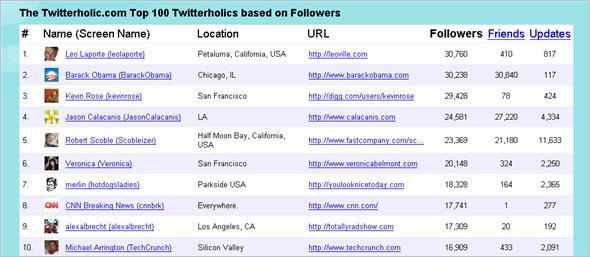
Take a look at this list of Twitter users with the most followers and you’ll see that almost everyone on it is famous or well known for reasons other than Twitter. For example, you’ll notice that the top 10 users are mainly all people who own popular websites/businesses and brands or have established a reputation through their involvement in different activities.
twitterholic
Run your eyes down the list further and you’ll notice the same thing: these Twitter users built their large audience through their already established popularity. They didn’t start from the ground up: it’s likely that they started with a decent amount of followers and will continue accumulate them passively through the strength of their reputation or personal brand.

Many people have built their following because they are well known away from Twitter, not because they were inherently entertaining or helpful as a Twitter user. In other words, they grew large follower base because they cleverly integrated their brand or what it is they do, with their Twitter profile. They used their websites or platforms to promote their Twitter profile

This doesn’t mean that you can’t develop a strong Twitter following if you are not famous for something online or offline. It can be done but in my opinion, building a Twitter following has little to do with how you use Twitter. I don’t believe that in order to get a sizeable audience, you need obsesses about specific tweeting etiquette.

I’ve never written any articles on how to use Twitter because I don’t think there’s an ‘optimal’ or best way to use Twitter, nor am I interested in regulating another person’s lifestream. Even if you’re purely using Twitter as a broadcast tool to increase your online influence, how or what you tweet is not really the thing you should be focusing on.

So let’s talk about what I think will help you to get more Twitter followers.

Maximize Visibility: Treat Your Twitter Profile Like Any Other Website

tweet
Image Credit: Tweet via QuickSilver
The first step is to understand that your Twitter profile is like any other website. You should treat it no differently from your own blog or a free opt-in newsletter. This means that if you want to increase your Twitter subscriber base, you just need to do one thing again and again:  

Drive web traffic to your profile. The more targeted the traffic, the better.

This sounds obvious but many people overlook this fundamental principle and focus instead on less relevant details like Twitter usage times/frequency. I’m sure that causing controversy or learning to tweet a certain way might get some extra exposure to your profile but in my opinion, the benefits are minimal.
 
How, when and what you tweet is not crucial.

When you want to catch as many fish as possible, use a large net and spread it as far as you can. The guideline to remember when building your profile is just one: keep working on sending visitors to your profile. People can only follow you when they know you exist.

With this in mind, you can play around with a myriad number of marketing strategies, just like how you would promote a website. Think in terms of incentives. Why would someone want to follow me on Twitter? How will he or she benefit from it? Assuming that someone doesn’t know who I am, what would motivate him or her to subscribe to my Twitter profile?
Here are just some examples of traffic-driving strategies (there are many more):
  1. Create a tool/application and promote your profile alongside it.
  2. Buy a banner ad to target tech-savvy audiences, link it to your profile.
  3. Use Twitter as a tool for tech/customer support.
  4. Organize a contest through your Twitter profile
  5. Include links to your profile in email/forum signatures.
  6. Evangelize Twitter on your blog/other blogs and include a link to your profile.
  7. Connect your blog and other social media profiles to your Twitter page.
  8. Learn to pitch Twitter influencers with articles relevant to their interest
  9. Explicitly ask another user to recommend your profile or exchange recommendations.
Apart from these strategies, there’s also another sure-fire way to increase your Twitter followers and this simply involves the act of following other users. Lets look at this in detail.

Mass Following Twitter Users: The Favorite Methodology of ‘Spammers’

Twitter is similar to many other social networks in numerous aspects, particularly when it comes to friending behaviors. Like Myspace, its possible to befriend a massive amount of users, some of whom will add you back as a friend. Continually adding Twitter users as friends allows you to increase the amount of followers you have.

This is a strategy that has worked remarkably well for early adopters when the Twitter was still a relatively new phenomenon. For example, I know a marketer who followed over ten thousand users and got thousands of followers in return. He then cut down the amount of people he followed and changed his username to make the account look legitimate.

Nowadays, the Twitter community has grown more aware of these ’spammers’ and many tools like the Twitter Blacklist and Twerpscan have been developed to help Twitter users weed out people who try to follow many users in order to build an large audience. Still, a portion of Twitter users (perhaps the new ones) tend to add anyone who befriends them.
Take for instance, Osen Komura. A fake profile set up by another Twitter user in February 2008 as a social experiment. The Osen account followed 41,798 Twitter users in one month and 7,847 users added him as a friend, a 17%+ follow-back rate.
osen
And Osen is not only the only profile out there with thousands of followers all derived through mass user following. The question is: Should you consider using the same strategy? 

Apart from the risk of being labeled a Twitter spammer and increasing the noise on your Twitter stream, this method still works. However, know that following so many users inevitably reduces your ability to keep track of individual users since they are drowned out by other updates, unless you conscientiously keep track of your Twitter stream or use RSS. But keep in mind that this is not essential. Here are some good reasons why you really don’t need to mass follow twitter users.
Scoble has suggested that it’s beneficial to follow many Twitter users because you get more access to information and it shows that you’re listening and more open to communication or meeting people. Perhaps so, but I would recommend increasing the people you follow on Twitter gradually, while making sure that you’re maintaining conversational interactiveness.

Most Twitter users don’t like it if you’re simply following him/her to broadcast a message and if you don’t monitor them equally in return or engage them in conversation. Unless you’re a popular celebrity of some sort, one-way attention doesn’t work very well for Twitter.
In any case, only viewing Twitter as a broadcast platform to drive traffic to your websites is a limited perspective, especially when your Twitter followers offer a wealth of knowledge, connections and opinions you can use to improve your business and personal skills.

Personally, I prefer building up an online reputation and driving traffic to my Twitter profile. For me, the benefits of Twitter come from using it as a conversational/networking tool, so I’m more concerned with whose updates I’m receiving daily and hence, the people I follow.
All in all, it depends on your goals and how you use Twitter. Feel free to share this article with your Twitter friends. I’ll love to get more feedback on this topic.

And yes…please follow me on Twitter and say hi! I’m always looking to follow new people so don’t hesitate to introduce yourself. I’m pretty friendly and open to new experiences.

Thursday, May 6, 2010

Twitter gets more quotable

Since quoting Twitter posts is all the rage in journalism these days, Twitter's launching an official way to do it. According to its Twitter Media blog, on Tuesday, the company will either unveil, launch, or roll out (they're being awfully coy about it) a way to embed tweets on third-party sites with a bit of HTML.

"No, really. It's very simple," the blog post explained. With "just a snippet of code, you'll be able to use to generate simple, selectable flat-HTML tweets."
It'll look like a screen-grabbed image of a tweet, except that the text in question can be highlighted and copy-pasted, and the content will link to the original tweet, as well as to the profile of the person who originally posted it. In other words, it gives members of the media another way to be lazy.

Indeed, Twitter says it was inspired by bloggers screen-grabbing tweets and embedding them in posts as images, calling that "a bit of a hack." But, the company observed, "the use of real tweets helps 'chunk' the piece both visually and logically; we think it makes it easier to read." 

Also, it means more of Twitter's official presence around the Web: it could be an obvious next step to tie some kind of data collection or analytics into embedded tweets to find out how much they're being linked out. (That said, Twitter "media innovator" Robin Sloan replied with "Nope!" when asked if these embedded tweets would be collecting any data.)

Wednesday, May 5, 2010

Impact of Facebook's Open Graph Good for Startups


It's been almost two weeks since Facebook's F8 developer conference, and we're still talking about the social networking site's announcements and the repercussions for the Web. Whileusers' privacy concerns continue to dominate much of the discussion, many developers and entrepreneurs are seizing the opportunity to not only access the wealth of data that Facebook's Open Graph promises but to serve the needs of the site's disaffected users.
We've written about many of the new tools that have been developed in response to Facebook changes, from those utilizing the new Open Graph protocol to those helping users migrate elsewhere.
"The Open Graph protocol enables you to integrate your web pages into the social graph. ... Once your pages become objects in the graph, users can establish connections to your pages as they do withFacebook Pages. Based on the structured data you provide via the Open Graph protocol, your pages show up richly across Facebook: in user profiles, within search results and in News Feed. -- from Facebook's description of the Open Graph protocol
Yesterday VentureBeat quoted LinkedInfounder Reid Hoffman as praising Facebook's Open Graph saying that "I think it's a great idea. It's very bold. It's a good poster to all entrepreneurs - 'here's how you can think big.'" Arguing that new companies will benefit from the social features the Open Graph will allow, Hoffman believes Facebook's changes will be a boon for Web 2.0 startups, particularly those that incorporate rather than challenge Facebook initiatives.
Indeed, Facebook has made the social plugins it introduced at F8 extremely easy to implement on websites. "Add social plugins to your site with just one line of html." And the impulse to link (via "like") to their social graph is compelling. With hundreds of millions of users who log in daily, Facebook is hard to ignore.
Some are calling this the end of the era of search and the beginning of an era of social recommendation. And while undoubtedly, this is a breakthrough for the semantic Web, it remains to be seen if the backlash from all the recent privacy concerns could be a reprisal of Facebook's missteps with its Beacon program.
And it remains to be seen how this will play out for startups as well. Arguing that Facebook's Open Graph will benefit startups, LinkedIn's Hoffman compared the social networking giant to a tanker ship. "Most companies will be able to pull their ships alongside the big Facebook vessel, but there are a few that will be destroyed, because they're directly in the tanker's path."
We have seen developers already quick to innovate around Facebook announcements - some incorporating the new data and some riding the wave of user distrust. What do you think about Facebook's Open Graph? Is it a vessel startups should pull up alongside? Or do you think startups should map a different route?

Facebook Study: Social Ads Perform Better


Nielsen and Facebook just released a collaborative study: Understanding the Value of a Social Media Impression. The study surveyed over 800,000 Facebook users and results show an increase in ad recall, brand awareness, and purchase intent when users see friends who have become fans of the brand in the ad. This is compelling data that backs up the main principle upon which SocialMedia.com was founded, which is: social ads perform better because they are a more personal, useful, and trusted form of advertising.
The research also revealed the high impact of campaigns that leverage a combination of paid media and earned media (i.e. ads drive users to become Facebook fans, and in turn users who become fans drive their friends to become fans). This type of social ad strategy is great because the positive effects of the campaign can be felt months after the campaign is over.
screen-shot-2010-04-20-at-24820-pm
SocialMedia.com’s own experience and research has shown what the Nielsen study also demonstrates.  A 2009 SocialMedia.com/ Dynamic Logic study on social advertising reveals significant attitudinal lift across very similar categories. In particular we saw increases in brand awareness, brand favorability, and purchase intent among groups shown a social ad versus a non-social ad.
screen-shot-2010-04-20-at-25912-pm
So yes, the study suggests that advertisers should consider social ads on Facebook, but advertisers should also be aware that social ads and their benefits don’t have to be limited to social networking sites. SocialMedia.com lets brands reap the benefits of social advertising beyond Facebook in 3 majors ways:
  1. For every action that a user can take on a social network (share, like, rate, comment, consume, etc) we enable users to take the same action in social ads, creating a more engaging social experience. People want to share, because the more you share the more credibility you gain in the social sphere.
  2. Similar to Facebook ads, users’ actions in our ads get pushed out into their social networks expanding a brand’s reach and creating real, organic messages about brands that appear in users’ news feeds, twitter streams, check-ins, etc.
  3. Our technology discovers actions users take (not just in the ad unit, but also organically on social networks) and transforms those actions and messages into authentic sponsored content, feeding social data back into the ad. Because we gather and organize third party social data (Twitter, Facebook, Yelp, Foursquare, etc) into a single technology engine, we offer the most complete social advertising solution that can’t be found anywhere else, even on Facebook.
And as I said in my comment on AdAge’s article on the study, “As long as we keep seeing impressive results and more studies like this one, we’ll keep repeating our mantra: In the future, ALL ads will be social.”